
Retail and distribution
Better data. Better retail operations.
In retail and distribution, master data is operational data. A missing barcode, a blank delivery plant or a store customer in the wrong sales area shows up on the shop floor, in the warehouse and on the invoice before anyone sees it in a report.
Where poor master data costs a retailer.
- Product availability
- An article without a valid EAN or base unit of measure cannot be scanned, received or sold. Two articles on one barcode send the wrong product to the till.
- Customer management
- Store, franchise and account customers carry account groups, regions and credit data. Wrong or blank values change how deliveries, credit and statements behave.
- Distribution
- A blank delivery plant means no supplying site, so the order cannot be created. The wrong one ships from the wrong depot.
- Sales and pricing
- A product not extended to the sales organisation, channel and division it trades in does not exist for that order. Blank pricing reference fields produce no price, or the wrong one.
- Material extensions
- Plant, storage location and sales area extensions decide where a material can be used. Missing ones block replenishment and sales; inconsistent ones split reporting.
- Operational reporting
- Reports built on failing records overstate availability and understate exceptions until failures are counted at the grain the business runs at.
Monitoring at the pace retail runs.
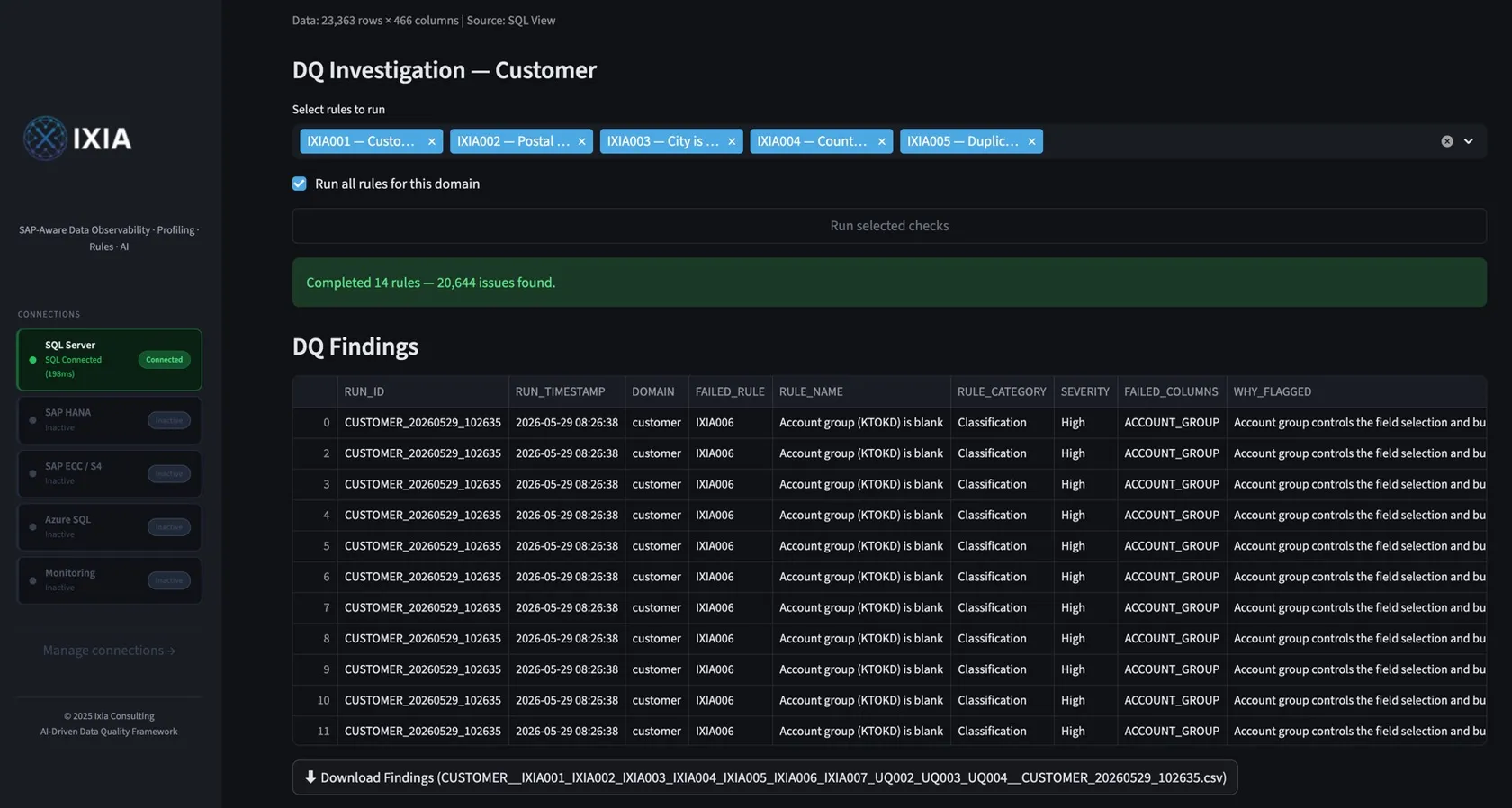
A one-off clean-up in a high-volume estate is out of date within weeks. Nightly monitoring that counts failures the way the business counts them keeps the master data usable.
- Every record, every night
- Rules run across the full master, not a sample, after the SAP extract lands. Failure files follow.
- Counted the way retail counts
- A material on eleven plant rows is one material. Every rule declares its reporting grain.
- The morning position
- A daily update email with the overall and per-domain failure rate, the handful of rules behind most failures, and whether yesterday's fixes held.
- Agreed exclusions
- Closed stores, inactive plants and test accounts are excluded by lists the data owners agreed, and reported with the results.
Ixia’s retail experience
Built for SAP programmes in South African retail and pharma.
Ixia delivered the migration workstream on a transformation that moved more than 2,400 stores onto SAP Retail across 11 go-lives in nine months, with stores trading throughout. The objects that break retail trading first, articles, pricing and site structures, are the objects the Ixia DQ rule library checks, because the library grew from a live SAP deployment rather than a whiteboard.
Case study: SAP Retail transformation- 2,400+
- Stores migrated to SAP Retail
- 11
- Go-lives in nine months
- 450
- Stores live in one weekend
See it on articles or store customers.
Start with one domain and see the first nightly run on your own extract before committing to more.