Skip to content
Ixia Consulting

TRUST

SAP-aware. AI-driven. Business-ready.

Data quality, governance and reconciliation, delivered as an operational control. Powered by Ixia Data Quality AI, our own platform, built from two decades of cleaning up enterprise data.

Data-quality failures are silent until they become expensive.

A wrong account group does not raise an alarm. A duplicate vendor does not send an email. The cost appears later, in a failed migration load, a mistrusted report, a payment to the wrong party.

Most programmes profile data once, fix what the deadline allows, and drift back. We built Ixia Data Quality AI so quality could be measured, explained and enforced continuously, in the terms SAP data actually uses.

Ixia Data Quality AI 2.1

One platform, from raw source to executive number.

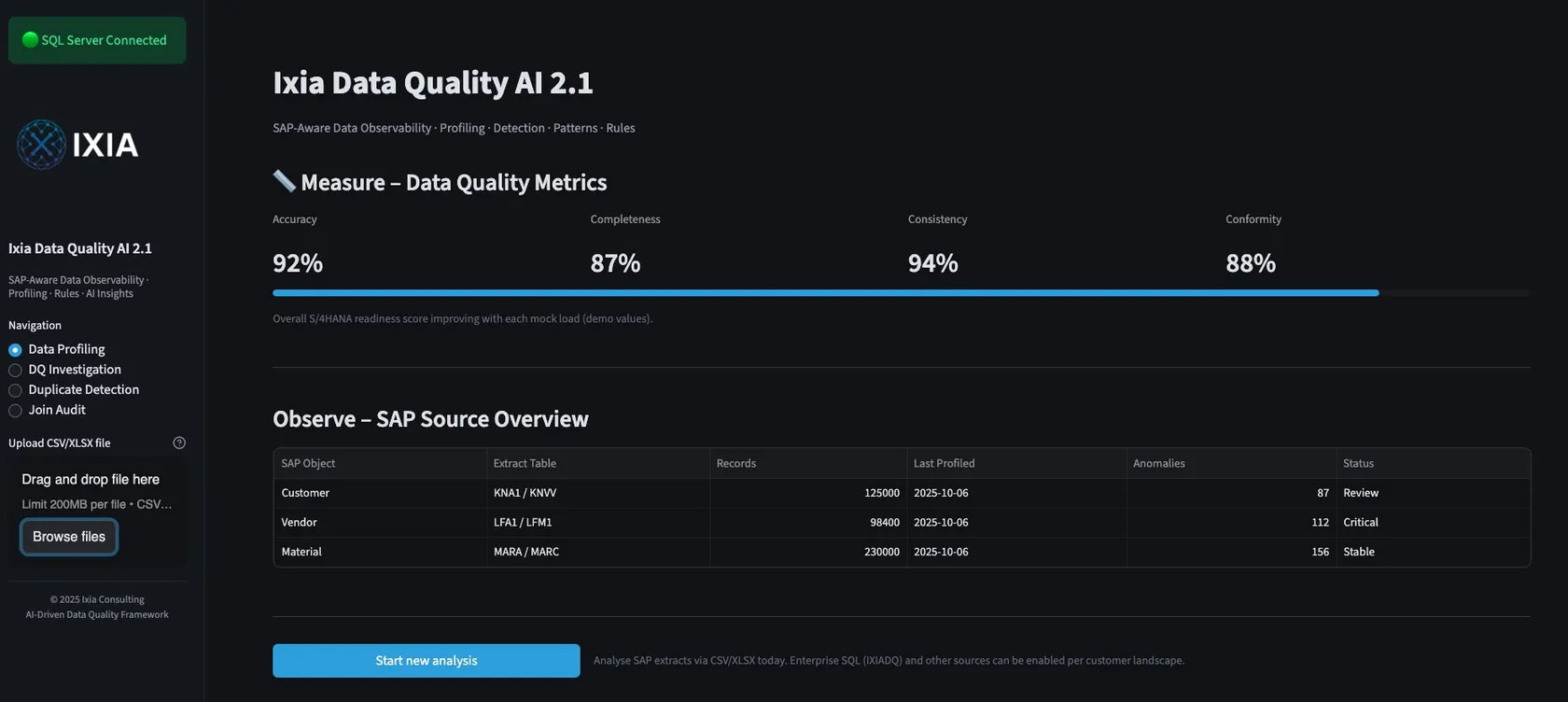
Connect to SAP S/4HANA, SAP ECC, DB2, MS SQL or PostgreSQL, or load flat files with automatic schema detection. Then measure accuracy, completeness, consistency and conformity against rules the business defined.

Ixia Data Quality AI overview measuring accuracy 92%, completeness 87%, consistency 94% and conformity 88% above a connected SAP source overview of customer, vendor and material tables
The Measure workspace: four quality dimensions over connected SAP customer, vendor and material sources, with anomaly counts per table.

How it works, screen by screen.

Every screenshot below is the working platform. Tap any screen to open it full size.

Understand

Profile the data as it actually is

Connect to the source or load an extract, and profile it: distributions, top values, blanks, outliers, structure. The platform shows the data as it stands, before anyone argues about it.
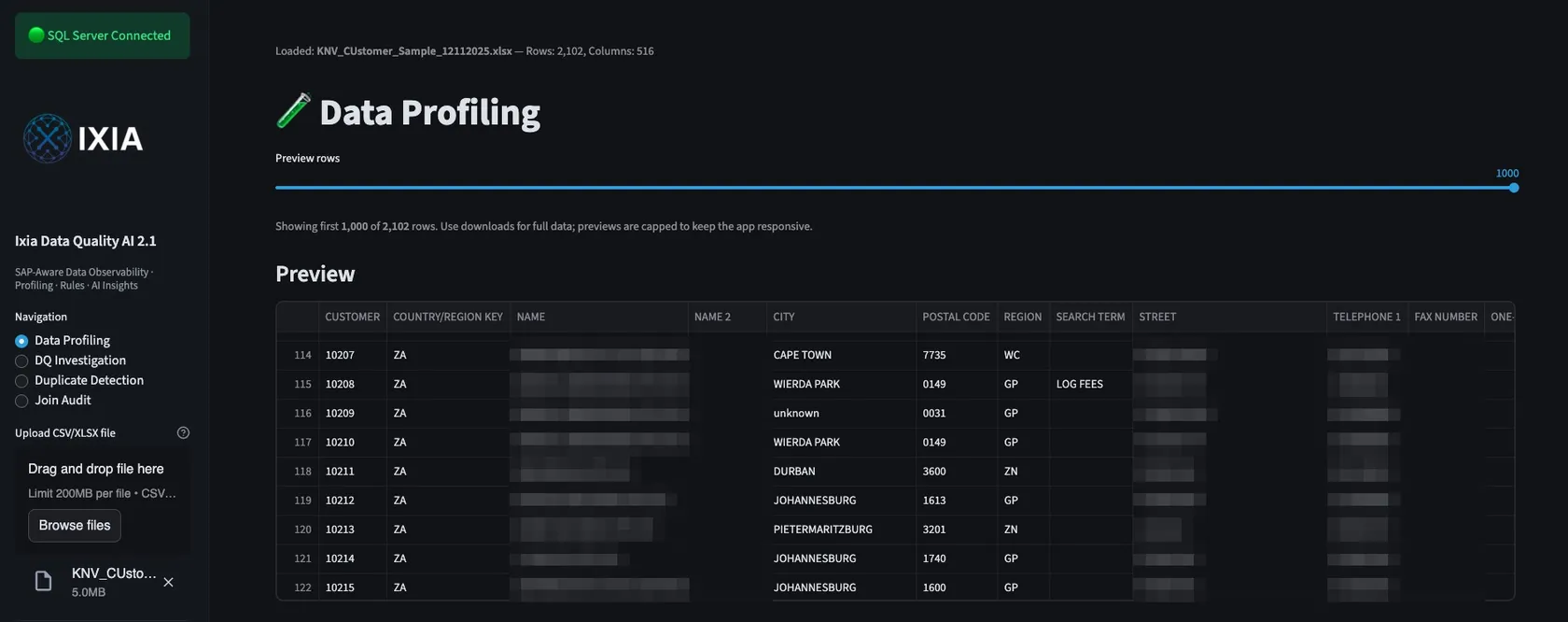

Data profiling view showing a live preview of a customer extract with thousands of rows across hundreds of columns
Profiling a customer extract: 2,102 rows across 516 columns, previewed straight from the source.

Classify

Let AI name every column, with confidence scores

AI column classification maps each field to a semantic type: identifier, address, code, name. Every assignment carries a confidence score, so a steward reviews the doubtful ones instead of all of them.

AI column classification map assigning semantic types such as CustomerID, CountryCode and Address to SAP columns with confidence percentages
Column classification on SAP customer fields, with per-column confidence.

Detect

Execute SAP-aware, business-defined rules

Rules are written in business terms in the Rule Builder: identity, logic, severity and the business context for why the check exists. SAP rule packs cover customer, vendor, material and sales area objects out of the box.
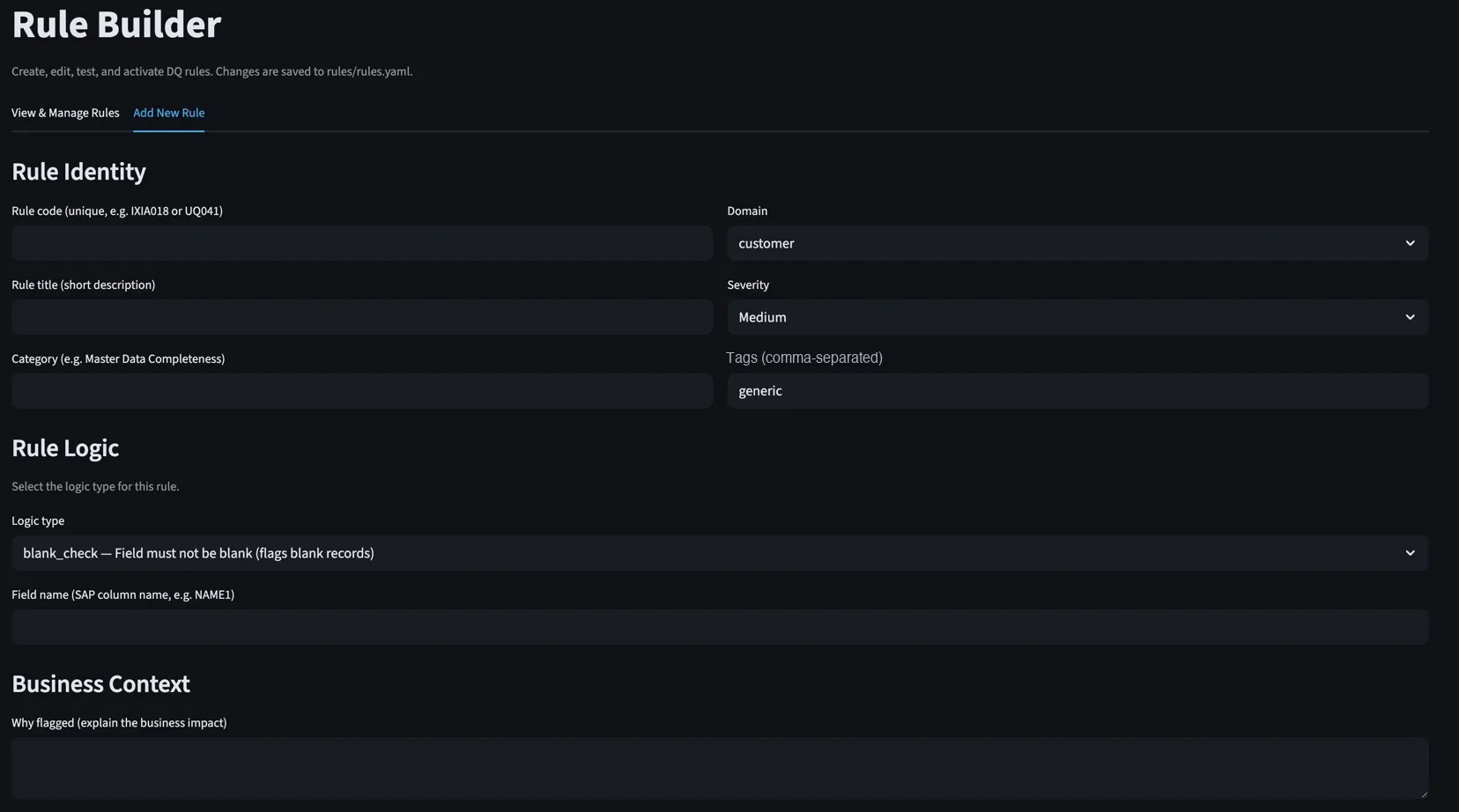
Rule Builder screen defining a rule with identity, blank-check logic on an SAP column, severity and business context
Authoring a rule: blank check on an SAP field, with severity and business context recorded.

Investigate

See the exact records, and the business reason

A run executes the selected rules for a domain and returns findings row by row: rule, severity, failed column, and why the record was flagged. Findings download as CSV for the people who will fix them.
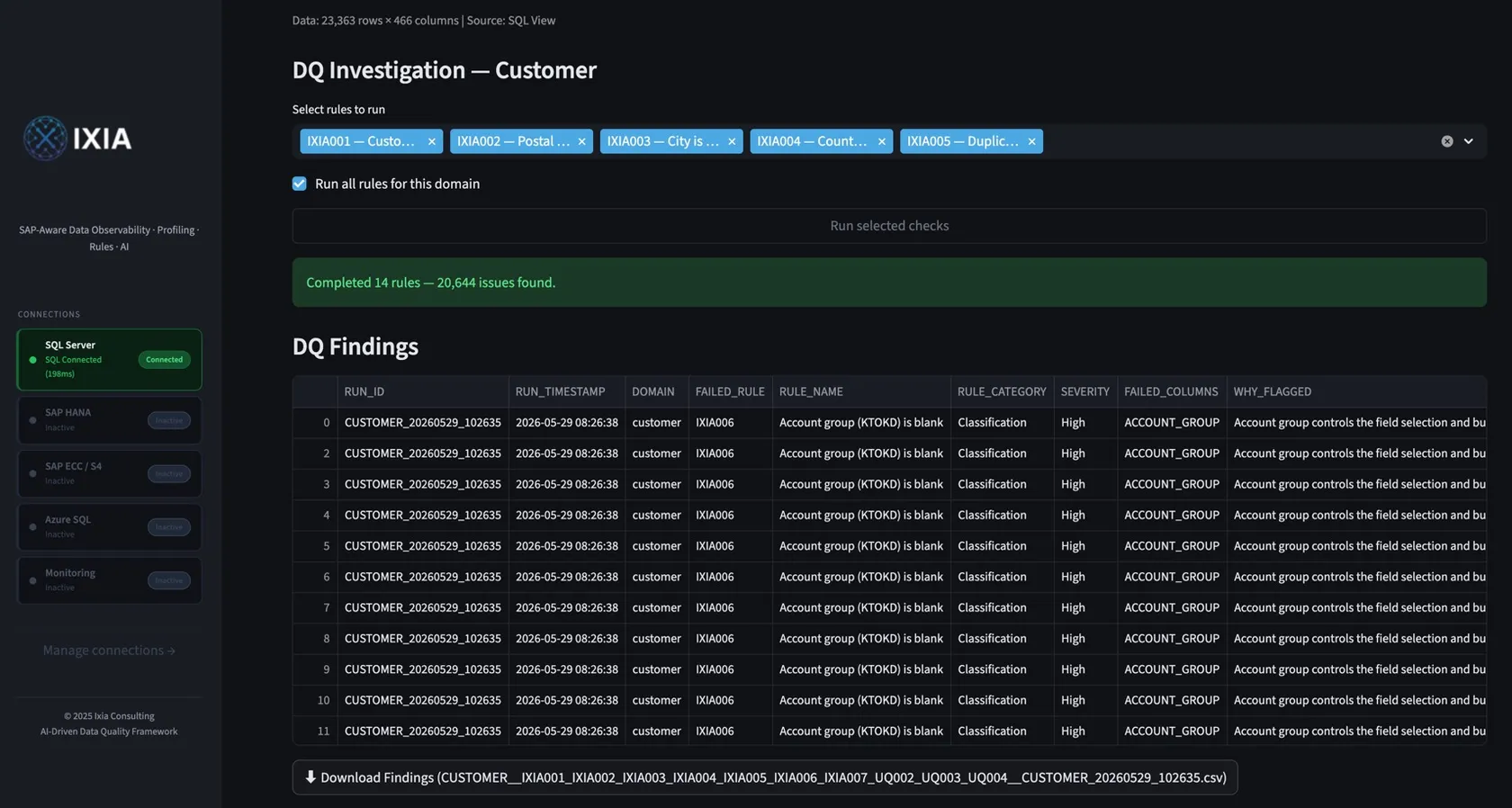
Data quality investigation on a customer domain showing 14 rules completed, 20,644 issues found, and a findings table with severity and reasons
One investigation run: 14 rules across a customer domain, 20,644 issues surfaced with reasons.

Recommend

AI turns findings into a prioritised fix plan

The AI analysis reads a run and writes what a good analyst would: an executive summary, key findings, root-cause patterns, a priority fix plan and recommendations. Teams start with the fix that moves the number most.
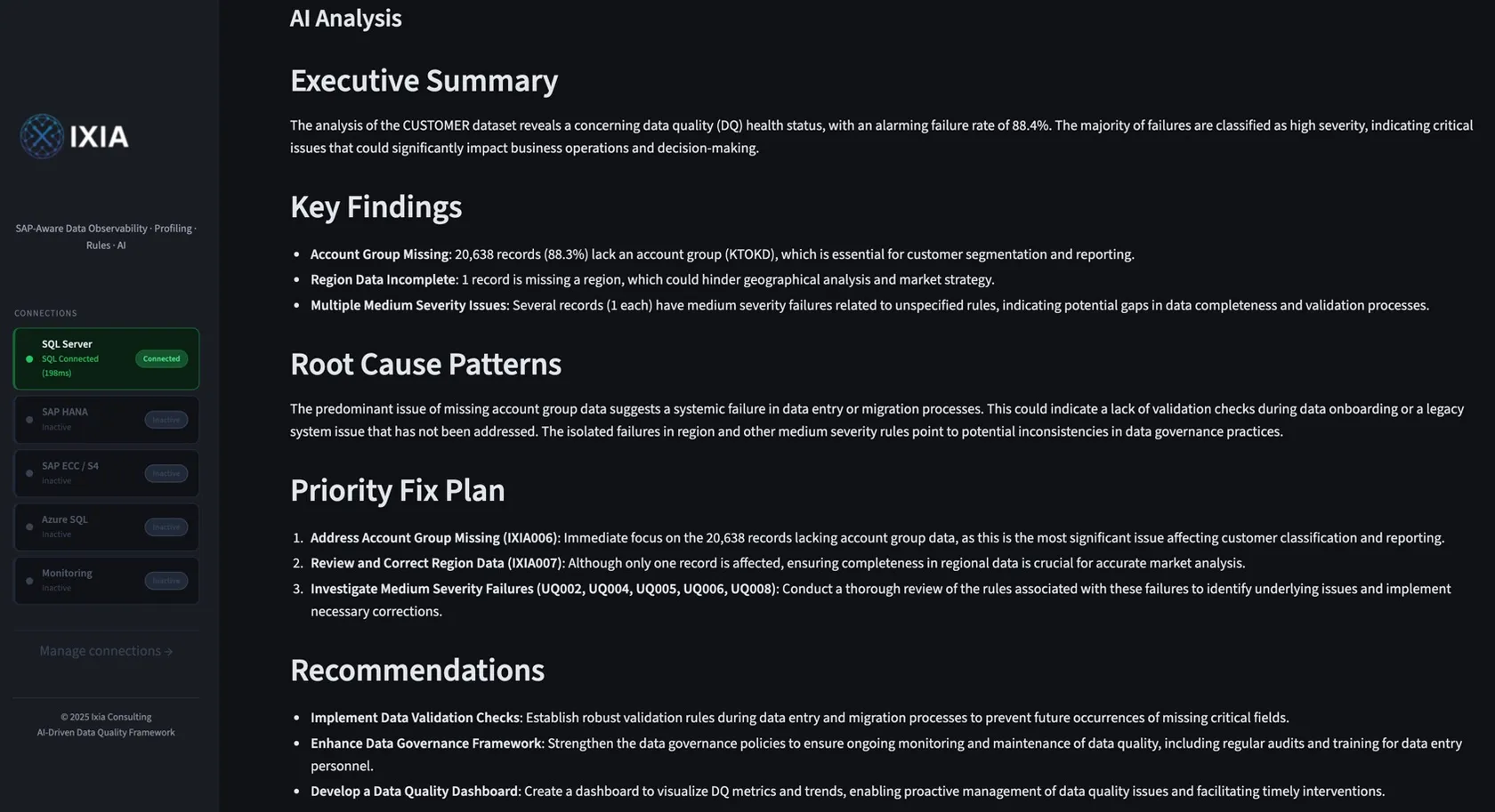
AI analysis of a data quality run with executive summary, key findings, root cause patterns, priority fix plan and recommendations
AI analysis of a customer run: root causes and a priority fix plan, written for management.

Remediate

Find duplicates, export the work list

Fuzzy and semantic matching clusters likely duplicates across names, cities and identifiers, scored by similarity. The result exports as a business-ready work list, not a slide.
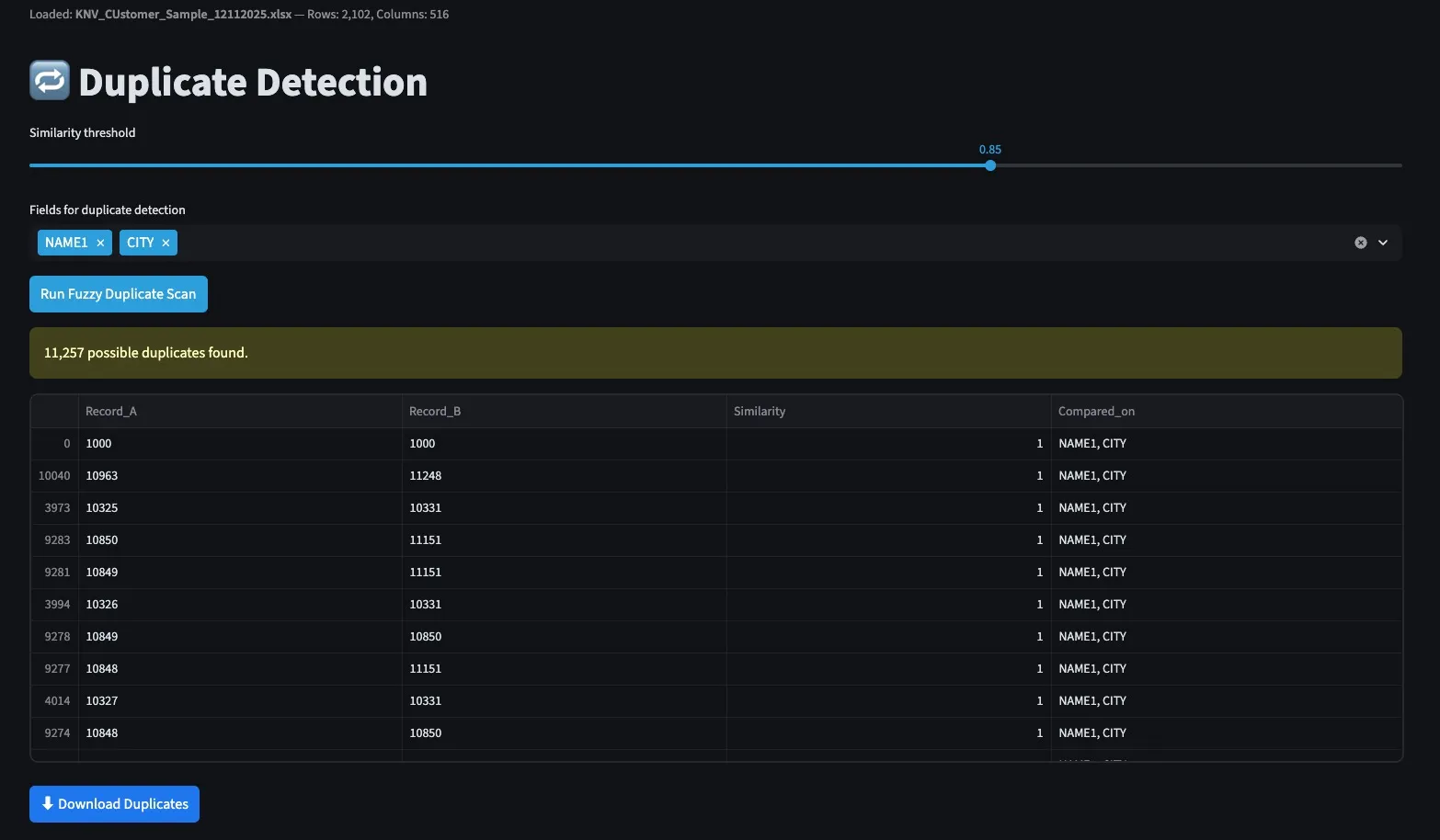
Duplicate detection screen with similarity threshold, matched field selection and 11,257 possible duplicates found with per-pair similarity scores
Fuzzy duplicate scan on name and city: 11,257 candidate pairs, scored and exportable.

Govern

Track every run, watch the trend

Run history keeps the record: what ran, when, how many records, how many findings, at what severity. The issue trend shows whether quality is improving or quietly decaying.
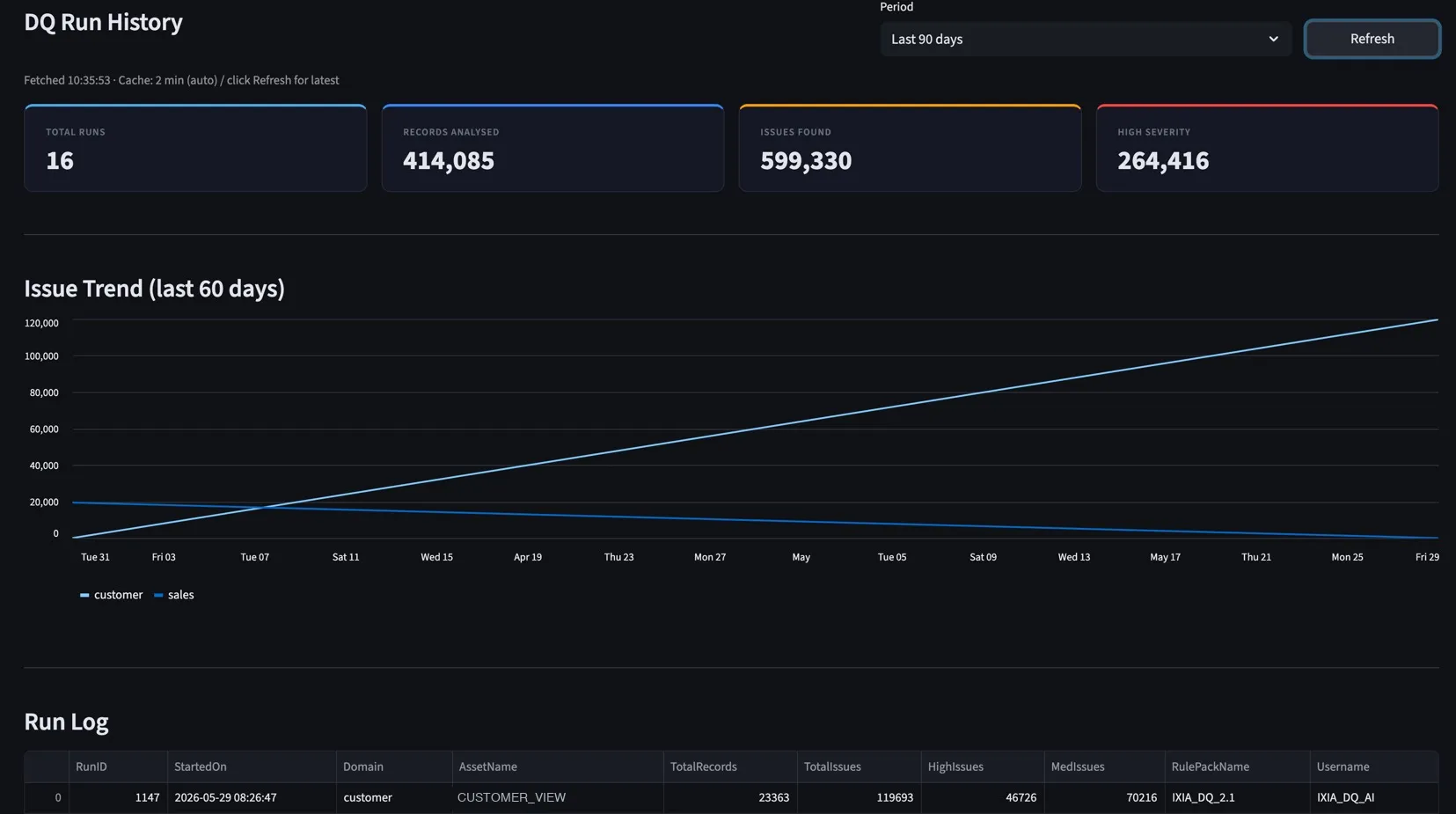
DQ run history showing 16 runs, 414,085 records analysed, severity counts, a 60-day issue trend line and a run log
Run history: 16 runs over 414,085 records, with a 60-day issue trend and full run log.

Manage

Executive visibility in Power BI

Findings feed a Power BI model: health score, failures by rule, daily trend and a written summary. Data quality becomes a number an executive can challenge, not a feeling.
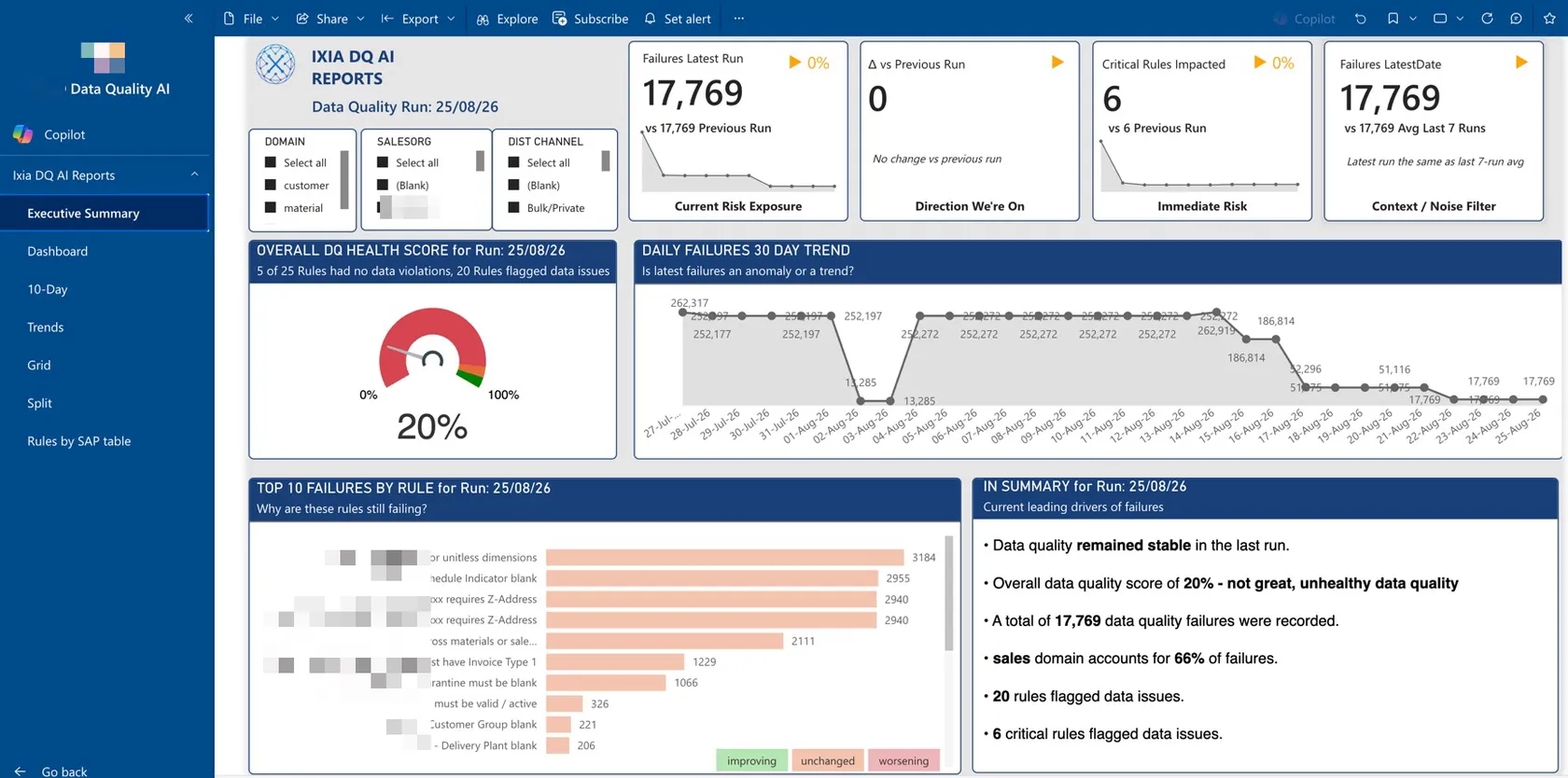
Power BI executive dashboard for Ixia DQ AI showing latest run findings, an overall health score gauge, top failing rules and a daily failures trend
The executive view: latest run, health score, top failing rules and direction of travel.

Quality is the engine. Governance is the steering.

Rules only hold if somebody owns them. We pair the platform with governance that gets adopted: clear ownership, glossaries that live in the tools people use, and council structures that meet, decide and act.

Explore Data Governance

Reconciliation, when the stakes are highest.

The same discipline runs through our migration work: value-level reconciliation, audit traceability and evidence packs the business signs. It is how a 30-year mainframe gets retired with zero post-load corrections.

Read the decommissioning case

Common questions

What is Ixia Data Quality AI?
Ixia's own SAP-aware data quality platform. It profiles data, executes business-defined rules, detects duplicates with fuzzy and semantic matching, generates AI recommendations with confidence scores, and feeds Power BI executive dashboards.
Which systems does it connect to?
SAP S/4HANA, SAP ECC, DB2, Microsoft SQL Server and PostgreSQL, plus CSV and Excel uploads with automatic schema detection.
Does it replace our existing data quality platform?
No. It fits your landscape as an accelerator, not a platform replacement. Rules stay in business language and findings export to the tools you already run.
What does the Focused Data Quality Assessment include?
One domain, Customer, Material or Sales Area, over four to five weeks: source connection or extract, profiling, rule assessment, duplicate detection, findings with severity and reasons, prioritisation and a management summary.

Focused Data Quality Assessment

One domain, assessed properly: Customer, Material or Sales Area. Typical duration is four to five weeks, and it ends with findings your team can act on, not a maturity model.

  • Source connection or extract
  • Profiling across the full domain
  • Rule assessment with SAP-aware packs
  • Duplicate detection
  • Findings with severity and reasons
  • Prioritisation and fix plan
  • Management summary

Scope

Customer / Material / Sales Area

Typical duration

4 to 5 weeks